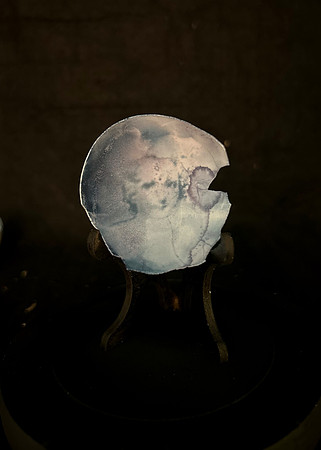
"Blue Madonna 2" by Edward Powers
Blue Madonna 2
Edward Powers
Media: Cyanotype on Eggshell
Size: 3.9" x 4.3" Glass Dome
Price: NFS
PROCESS
Eggshell Preparation: Gently remove as much of the egg membrane as possible by hand. Then, soak the eggshells in bleach for 20-30 minutes to dissolve the membrane. The remaining membrane inside the eggshell should turn slightly brown. Once the brown color disappears, the membrane has been completely dissolved (this may take several soaks). Afterward, place the eggshells in a hydrogen peroxide/water bath to stop the bleaching process. Allow the eggs to dry thoroughly.
Negative Preparation: Using a large rectangular baking dish (larger than 8.5 X 11 inches), gently stretch a high-quality cling film or plastic wrap, ensuring there are no wrinkles. Spray a sheet of letter-size card stock with a very low-tack spray adhesive or a spray adhesive specifically designed for stencils. Gently place the card stock on the stretched plastic wrap, applying gentle pressure to ensure even contact between the paper and the plastic wrap. Carefully remove the plastic wrap/card stock from the baking dish. Coat the plastic wrap with a heavy coat of InkAid™ Clear Gloss Precoat Type ii. Allow to dry for 12-24 hours. After the InkAid™ is thoroughly dry, trim the plastic wrap from the edges of the cardstock. Place the prepared cardstock into your printer. Prepare the image as you would any cyanotype negative, adjusting curves, color, inverting, etc.
I prepare 3 or 4 images at a time. Using a program of your choice, lay out the negatives to the preferred size. My square tiles are approximately 2 1/2 inches in size. Print to your inkjet printer and allow the ink to completely dry, approximately an hour. Stretch another piece of cling wrap on your baking dish and place the printed sheet face down, sandwiching the ink between the two pieces of plastic. You can now cut out the negative and remove the plastic from the card stock. The negative is then placed on a curved surface (I printed out different sizes of egg shapes on a 3D printer) and gently warmed and molded with a hair dryer at a low temperature.
Preparing the egg with emulsion: Using a fine mist spray bottle, coat the inside of the eggshell with an even coat of ferric ammonium citrate. Make sure the ferric ammonium citrate does not puddle in the bottom of the eggshell. You may gently rotate the eggshell, allowing for an even coating, and then turn the eggshell upside down or dry it with a hair dryer on a low setting. Repeat the process so that the eggshell has two even coats of ferric ammonium citrate. Place the curved negative in the eggshell and make sure that it touches the shell. This can be a very frustrating process!
Once the negative is in place, develop it as you would any cyanotype. In my case, the eggshell is exposed to a 40-w UV light for 3 minutes. Once developed, the eggshell is sprayed with potassium ferricyanide, exposing the image.
I have found that the success rate for this process is about 30%. Your results will vary.
BIO
Edward Powers, a retired University Professor, taught Theatrical Design/Technical Direction at Clarion University (now PennWest) in Clarion, Pennsylvania, for 30 years. Thirteen years ago, he began exploring alternative photography by constructing a 3D-printed pinhole camera. His photos have been exhibited at the Pavlovka Pinhole Fest in 2024 and 2025. Recently, he developed an interest in alternative processing, primarily working with cyanotype, but also exploring anthotype and chlorophyll printing. He is honored to be part of (S)Light of Hand 2025.