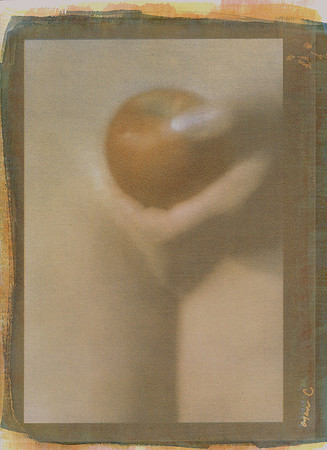
"Eve's Apple" by Barbara Wilson
Eve's Apple
Barbara Wilson
Media: Gum Bichromate Pinhole
Size:
Price: NFS
Artist Statement:
There has always been a bit of mystery in photography, capturing the moment. But there is something else that makes a photographic image more than a representation or record of what is in front of you. Finding the miracle of the moment, the inner vision of the photographer pushing the shutter, that is what art photography is about. The picture has to go beyond a pretty place or a recognizable person. You know it when you see it. The image speaks to you and takes you on a journey. Working with alternative processes helps to jump the gap often by miracles from mistakes. Great images aren’t about techniques or technology. It doesn’t matter how you get to the final product. You just know when you are there.
Photo Process:
My process begins by first taking a photograph using an old Agfa bellows camera, usually mounted on a tripod. I turned it into a pinhole camera having replaced the lens with a shim of brass with a tiny pin hole. The camera takes 120 film and the negatives are 21/4 X 31/4 inches.
I use an incident light meter set at ISO 5 f64. The exposures run from a few seconds to ten minutes. I use both black & white and color negative film ASA 400. I process my black & white and send the color out to a commercial lab.
The film negatives are scanned into digital images. Then the ‘darkroom’ work is done in Adobe Photoshop. Working with Diana Bloomfield’s process, the image is broken down into tri color separation negatives that are printed using an Epson SureColor P800. My images do not begin with a cyanotype image that is layered with color. I work only using watercolor pigments that are mixed with dichromate and gum arabic. Transparent color layers are built over one another similar to painting with glazes. The color mixture is coated unto a sheet of Hahnemühle Platinum Rag paper and dried before one of the separation negatives is contact printed using a UV light source. The exposed paper is developed in water, washed and hung to dry. Then the next color layer is added.